

New York City boasts an unparalleled wealth of restaurants, yet surviving in the city’s fiercely competitive culinary landscape remains a challenge. Economic pressures, rising food costs, and shifting dining trends test the endurance of even the most iconic venues. Despite these obstacles, a resilient cadre of restaurants has defied the odds, some tracing their roots back over a century.
In 2024, several renowned establishments mark significant milestones. For No Taste Like Home, we’re highlighting a handful of influential favorites: restaurants that have shaped the fabric of today’s dining culture in NYC.

THE ERA
In 2004, New York City settled into the Bloomberg era as the city healed from 9/11 and reconstruction on the World Trade Center site broke ground. The first Shake Shack opened in Madison Square Park; The Time Warner Center debuted with Masa, Per Se, Jean-Georges Vongerichten’s V Steakhouse, and Gray Kunz’s Café Gray. This restaurant opened with the intention of going against the grain.
Barbuto
February 2004
113 Horatio Street at West Street, West Village

How it started
By 2004, Jonathan Waxman was a legend in the culinary world. An important figure of the American food revolution in the ’70s, Waxman made his name in New York in the ’80s with the opening of Jams on the Upper East Side, wowing diners with his signature roast chicken, and landing on Esquire magazine’s list of “most influential Americans.”
In 2003, after being, as he described in The Barbuto Cookbook, “ kicked out” of his Greenwich Village restaurant, Washington Park, Waxman decided to simplify his ambitions. His friend, an Italian photographer, convinced him to open an Italian restaurant at the bottom of his photo studio in the “quietly destitute” far West Village, then known for its meatpacking plants and clubs. With a brief menu of simple pastas, Waxman’s modest vision became a reality.
As Eric Asimov noted in his 2004 review, “[Barbuto] emphasizes the close ties between Mr. Waxman’s brand of California cuisine and the rustic, intensely seasonal cooking of the Italian countryside. Best of all, the main courses are under $20, and almost all appetizers are under $10, providing a rare opportunity to try a celebrity chef’s work without celebrity prices.”
Opening night, according to Waxman
“All I remember is I just worked my ass off. It was only my then-chef Lynn McNeely and myself, and Heather Miller, our pastry chef. One waiter. One bartender. I don’t know if we had a host. I didn’t think anybody would come.”
The menu, then and now
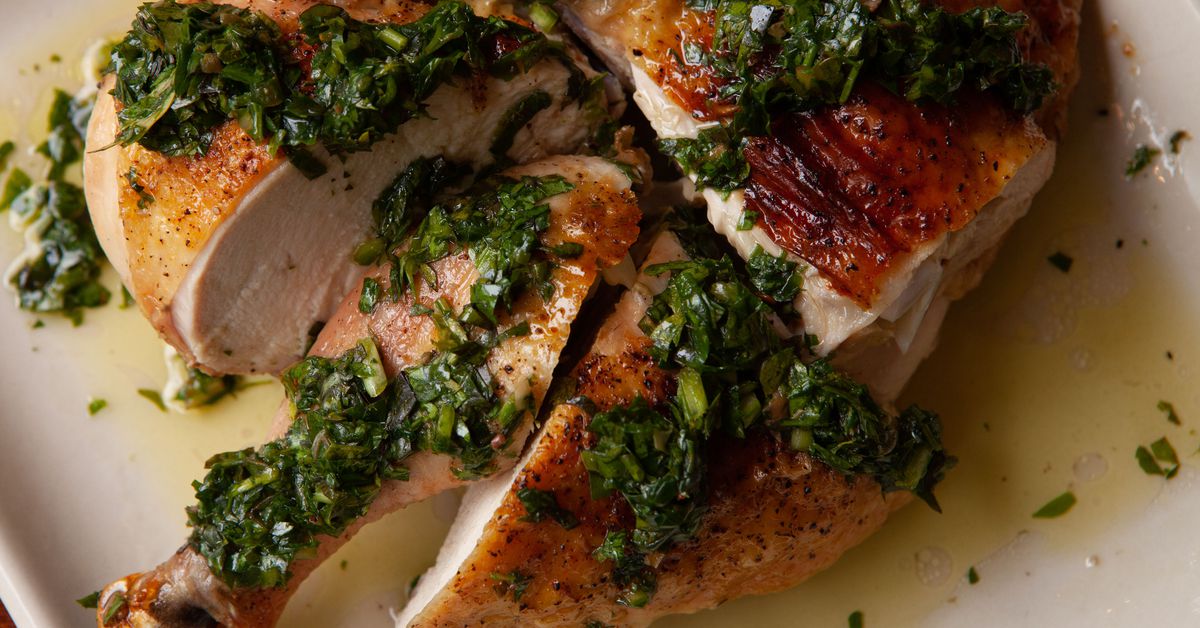
“When we opened, I decided that nothing on the menu would be over $19,” Waxman says, which caused it to be originally reviewed in the Times’ $25 and under column, where Eric Asimov highlighted entrees starting at $14. Waxman’s signature roast chicken has been on the menu since day one, when it was $17; today, the bird goes for $32, with other entrees $26 to $47.

Why it endures
In the same year that fellow celebrity chefs Thomas Keller, Jean-Georges Vongerichten, and Masa Takayama were reveling in the splashy new Time Warner Center, Waxman was extolling the neighborhood restaurant.
“I tried to keep away from tweezers and foam and that stuff,” he says. “I think that’s what New York really needed then, in the wake of 9/11. The word ‘restaurant’ means to restore balance. That’s what I tried to do.”
Waxman has long been known as a great mentor. Some of the proteges of Barbuto’s kitchen include Justin Smillie (Il Buco, Upland), Hunter Lewis (Food & Wine editor-in-chief), and Jake Leiber (Chez Ma Tante, Le Crocodile). Both Le Crocodile and Sempre Oggi on the Upper West Side have its famous chicken dish dressed with herbs and lemon on their menus as an homage to Waxman and Barbuto. Today, executive chef Ty Johnson still keeps it simple and seasonal, with pastas, pizza, salads, and that renowned roast chicken. Though not in its original digs — the restaurant moved to nearby Horatio Street in 2021 — Barbuto continues to thrive, with Waxie’s, a subterranean private dining venue and a series of celebratory dinners welcoming guest chefs such as Marcus Samuelsson and Marc Vetri, running throughout the rest of the year.
This article was originally published by a ny.eater.com . Read the Original article here. .