

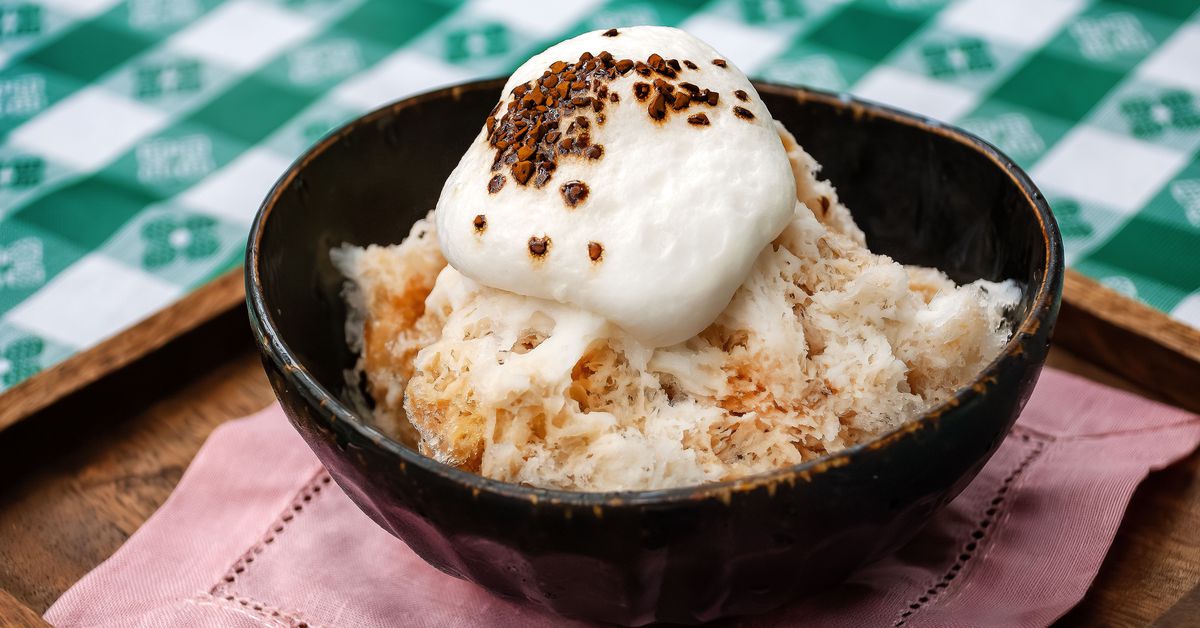
If there’s a summertime dessert trend that is worth its weight in gold, it’s the unbelievably delicate, fluffy, almost cotton candy-like confection made from pristine blocks of ice. And Tonari in Chinatown is now the only purveyor in the city offering the Japanese delicacy called kakigori. On Thursday, July 25, Japan celebrates a national holiday in homage of the shaved ice sensation that’s cemented its place in dessert history as one of the most technically challenging, chemically intriguing dishes on any menu (707 6th Street NW).
Why July 25? The pronunciation of the date sounds similar to “summer ice” in Japanese. But anecdotally, on the same day in 1933, Yamagata, Japan saw record-high summer temperatures that required an over-consumption of the frozen treat. To commemorate the annual ode to kakigori, Tonari will sling the sweet for free today from 1 p.m. to 2:30 p.m.


Literally translated, “kakigori” is the Japanese term for “shaved ice” in English. But ask any child, adolescent, or adult who knows the dish, it’s so much more than that.
“I grew up with shaved ice desserts in Hawaii, so I thought I knew what that category of food would taste like,” says Katsuya Fukushima, chef and co-owner of Tonari and Daikaya Group. “But when I first tried kakigori as an adult — maybe 20 years ago — I was blown away.”
Tonari, the next-door sibling of D.C. ramen standard-bearer Daikaya since 2019, specializes in wafu (Japanese-style) Italian noodle dishes and pizza prepared in a deep-dish pan like one might find at a Pizza Hut in Tokyo. The sleek nighttime staple recently expanded hours with a cafe component serving all sorts of Japanese-Italian mashups for breakfast and lunch.
It is difficult to describe kakigori to the uninitiated. Definitively unlike the icy, crunchy snow cones that most folks have grown up with, kakigori is especially smooth. The decadent texture is not quite meringue or buttercream, but feels like something that should adorn the top of a celebratory cake. This distinctively creamy mouthfeel is no accident, but rather something that Fukushima has spent months perfecting.
“It’s all about the ice,” says Fukushima, who debuted the delicacy a few weeks ago at Tonari for the time time. “We import our ice from Japan to make sure that it’s the exact purity, clarity, and quality we need it to be.”
Getting the ice from the freezer to the kakigori machine is a meticulous process in itself, he notes.
“We have to first temper the ice in the refrigerator for an hour before bringing it to the ice shaver itself,” says Fukushima. “And the problem is, as soon as you load the ice, it starts to melt.”
Key to this quality is the chemical makeup of the ice.
“The water that is used to create this ice is very basic and has truly very little flavor,” he says.

Rather than taking an entire canister of mineral water and freezing it at sub-zero temperatures, Fukushima imports his ice from a Japanese purveyor that takes seven days to freeze its ice on a layer-by-layer basis to create a particularly feather-like quality to the shaved snack.
“We’ve tried freezing our own ice and sending it through the machine, and it’s just not the same,” says Fukushima. “We just end up with a more brittle texture that’s not nearly as unique or notable as real kakigori.”
From Tonari’s standpoint, the pressure is on to prove the distinctive nature of Japan’s iconic dessert.
“So many other countries have shaved ice for their warmer months,” says Fukushima. “But I feel very strongly that this is unlike anything that most folks have tried, at least from a textural standpoint.”
Purists through and through, the team has been relatively conservative with its exploration of flavors to date. Kakigori at Tonari can be experienced in only five flavors: coffee, strawberry, matcha, watermelon, and lemon ice.
“Technique is critical to kakigori, so I wanted to perfect that element before going crazy on the flavors themselves,” says Fukushima. “But as we continue to evolve, I have plenty of off-the-wall flavors, like a sweet tomato syrup or a liqueur-based kakigori for folks to try.”
As more D.C. denizens discover the delights of kakigori, Fukushima plans to explore new and creative flavor profiles.
“So far, I’ve just been learning how to perfect the technique of the kakigori,” says Fukushima. “But over time, my hope is to bring my full creative license to the dessert.”
This article was originally published by a dc.eater.com . Read the Original article here. .