

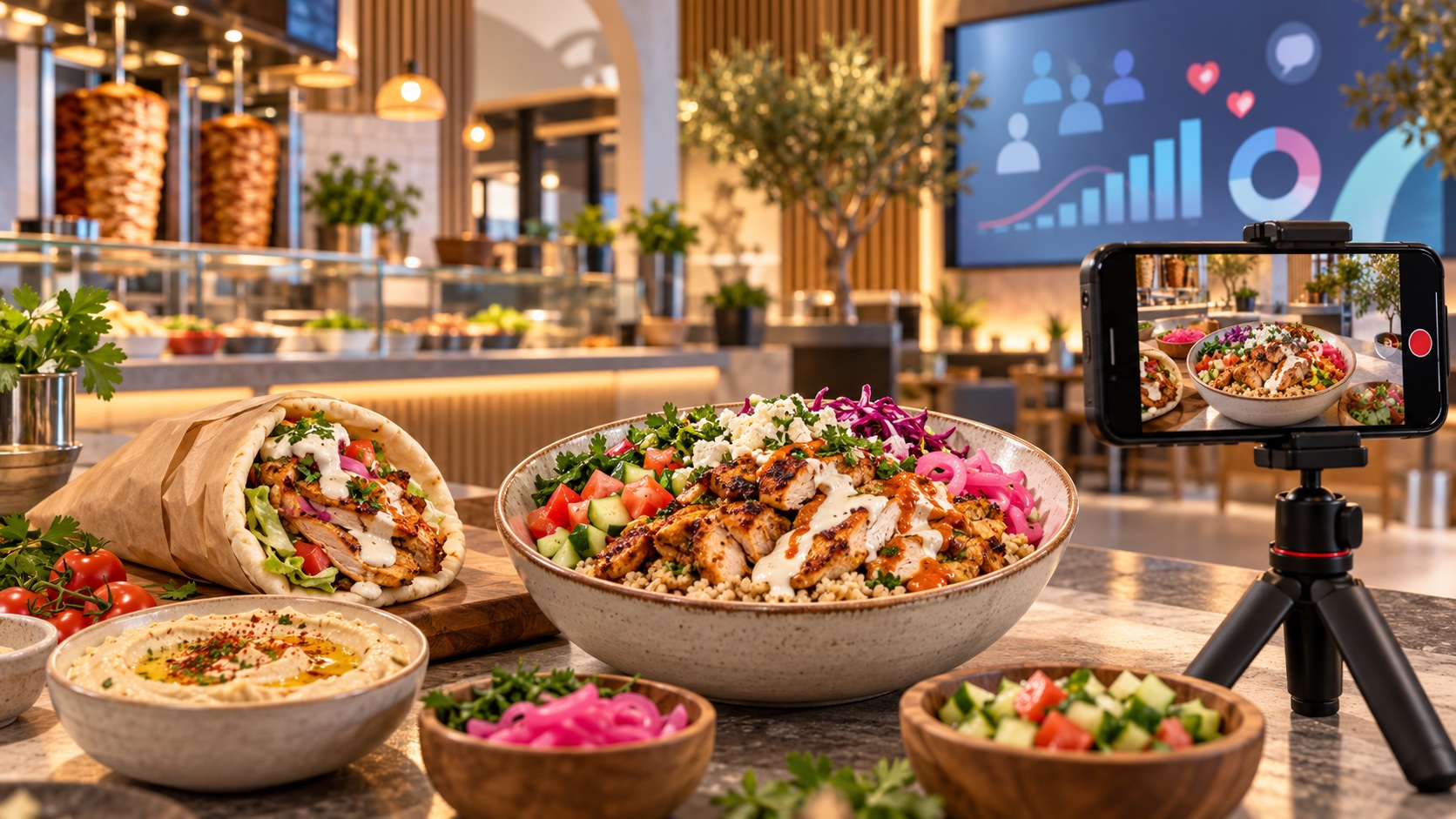
Tahini’s built a large online audience by filming shawarma, sauces and the work behind its restaurants. Now the Canadian Mediterranean fast-casual chain is treating that audience as more than a customer-acquisition channel: it has become part of the company’s franchise pipeline.
In a new interview with Fast Casual, Tahini’s said prospective operators are finding the brand through the same YouTube, TikTok and Instagram content made for diners. The company reports more than 3 million YouTube subscribers and more than 2 billion video views. Those figures are company-supplied reach metrics, not evidence of restaurant profitability, but they help explain why Tahini’s says it can generate franchise interest without relying primarily on traditional franchise brokers.
The strategy arrives as the chain pushes farther into the United States. Tahini’s official franchise page says it now has more than 80 locations, 60 additional restaurants under development across North America and seven U.S. locations in development following its first American opening in Loves Park, Illinois, near Rockford. The company identifies New York, New Jersey, Alabama, Atlanta, Maryland, Texas and Illinois as expansion priorities.
Food content that doubles as operator recruiting
Most restaurant brands separate consumer advertising from franchise-development marketing. Tahini’s is blurring that line. Videos about menu preparation, new openings and day-to-day operations can attract a hungry customer, but they also give a potential owner a view into how the concept presents itself and how its audience responds.
The chain told Fast Casual that franchise lead Juliet Noronha first encountered the brand after her son watched its videos. She later became an operator in Toronto. It is one example, not proof that the same path will work in every market, but it shows how a consumer follower can move into the development funnel.
The company’s approach also changes the role of a grand opening. Instead of treating the event only as local promotion, Tahini’s can package it as content for a much larger audience. A busy opening, a behind-the-scenes kitchen sequence or a new menu item can simultaneously advertise the restaurant, demonstrate demand and introduce the franchise opportunity.
There is a practical advantage to that system: the audience already understands the brand’s tone and food. A lead arriving through those channels may need less explanation than someone who first sees the name in a franchise directory. Tahini’s says it compares traffic and sales after a viral post with prior periods and asks customers how they heard about the restaurant, which is a more useful test than counting views alone.
What the expansion offer includes
The official franchise materials describe a relatively compact restaurant model, generally 1,400 to 1,800 square feet. Tahini’s says estimated build-out costs typically range from $400,000 to $600,000 and that franchisees should have at least $200,000 in liquid cash. Elsewhere on the same page, it lists a preferred operator profile with $250,000 in unencumbered cash, a $350,000 net worth and a credit score of at least 720. Those figures are marketing-page qualifications, not a substitute for the current Franchise Disclosure Document or a market-specific budget.
The company says prior restaurant experience is not required. Its promised support includes training, operations guidance, site selection, marketing, supply-chain management and assistance during lease review. It also says more than half of its franchisees own multiple locations.
Tahini’s has set an aggressive long-term target of 500 U.S. locations within five years. That is an ambition rather than a committed opening schedule. Restaurant development depends on suitable sites, leases, permitting, construction, financing and operators who can execute the model. The official page says a build-out can take about three months after permits are secured, while the full process can be much longer.
Social reach is not unit economics
The most interesting part of the strategy is also the part prospective owners should examine carefully. A large following can reduce the cost of awareness, but a video view is not a restaurant transaction. National or global engagement does not guarantee repeat customers within a particular trade area, and viral traffic can fade faster than rent, labor and food costs.
The Federal Trade Commission says prospective franchisees must receive a Franchise Disclosure Document at least 14 days before signing a contract or paying the franchisor or an affiliate. The document contains 23 categories of information, including fees, litigation, outlet history and any permitted financial-performance representations. The FTC also recommends speaking with current and former franchisees and checking whether any sales or income figures are representative of the market being considered.
That review is especially important when the first attraction is a compelling content feed. A polished digital presence can demonstrate brand awareness and marketing ability, but the investment case still rests on disclosed costs, realistic local sales, staffing, lease terms and owner involvement.
Tahini’s has found a distinctive way to connect those two worlds. Its videos can sell lunch today and introduce a future operator tomorrow. Whether that advantage translates into durable U.S. growth will depend less on subscriber totals than on how the new restaurants perform after the opening cameras move on.