

By Caroline Hatchett
For The Washington Post
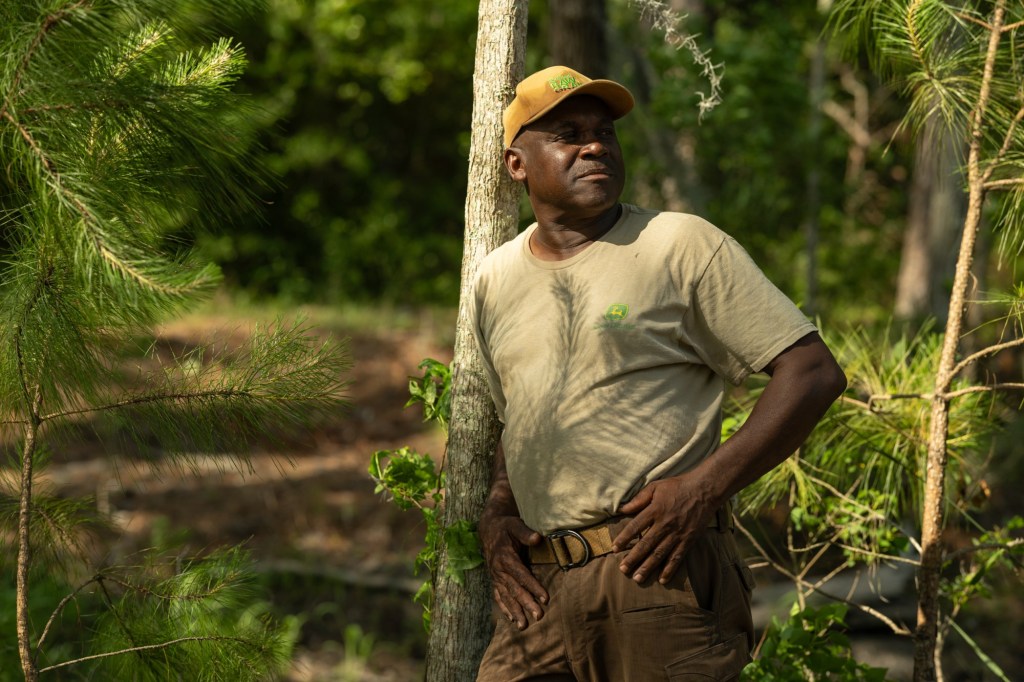
HARDEEVILLE, S.C. — In late October, Marion “Rollen” Chalmers stood next to a rice field ringed by pines and palm trees. He pointed out roseate spoonbills as the birds launched from their perches, trails left by alligators’ tails as they crisscrossed a dike, and, with clear satisfaction, to new growth sprouting from Carolina Gold rice stems. The farmer had harvested the field more than a month earlier, but he did not uproot the plants. So after re-flooding and fertilizing, a second crop, known as the ratoon, had started to emerge.
“These fields are just like they would have been in the 17th or 18th century,” says Chalmers, 60, a fourth-generation rice farmer whose Lowcountry roots stretch back hundreds of years.
Plenty of Americans have eaten rice grown by Chalmers — even if they don’t know it. Chalmers is a longtime collaborator with Glenn Roberts, founder of Anson Mills and champion of heirloom grains, and for close to two decades, he has worked in the background of South Carolina’s rice revival. The farmer grows organic rice, among other crops, at Turnbridge Plantation, where Richard Schulze Sr. resurrected nutty, aromatic Carolina Gold rice in the late 1980s.

More than a sower of seeds, Chalmers works as a fixer, research grower, hydrologist, woodsman, field and fence builder, and ancestral knowledge keeper. “There’s not one farm we have with rice on, and we have a lot of them, that Rollen hasn’t been to and advised on,” Roberts says.
In spring 2023, Chalmers added another title to his multi-hyphenate CV: rice seller. With his wife, Frances, Chalmers launched Rollen’s Raw Grains, his own line of rice, peas and grits sold online, at farmers markets and at the couple’s Hardeeville storefront. “For years, I kept thinking about doing something like this, but I get involved in so many other projects,” Chalmers says of his later-in-life public debut. “It’s a big accomplishment.”
The previously unsung farmer now has chef fans (BJ Dennis, Pierre Thiam, Bernard Bennett and Mashama Bailey, among others) and a growing number of loyal home cooks, and for Chalmers, the state’s most visible Black rice farmer, each pot he fills is a quiet triumph of culture.

Rice made South Carolina planters rich. By 1774, the coastal region exported some 66 million pounds annually of the grain, all sowed and harvested by enslaved workers in treacherous fields infested with water moccasins and mosquitoes. Plantation owners sought out West Africans, in particular, for their skill in growing and processing rice. “Enslaved Africans taught Americans how to grow rice,” says Bailey, chef and co-owner of the Grey, a restaurant in nearby Savannah, Ga. Posters for Lowcountry slave auctions advertised workers from the “Windward and Rice Coast,” as well as a “gang of 25” “accustomed to Sea Island cotton and rice culture.”
After the Civil War, many planters sold or abandoned their land, and South Carolina’s commercial rice farming faded in the face of mechanization (the region’s sticky pluff mud is not kind to tractors), labor shortages and outside competition. By the time Chalmers started farming rice, the fields that fueled the state’s antebellum economy had largely become ghosts, earthen memories pressed into the landscape. To see them now, researchers use aerial photography and lidar, an advanced type of imaging, to map fields’ man-made boundaries.
But rice culture was tended all along by the Gullah Geechee people, descendants of enslaved West Africans, who, after emancipation, stayed put in the Southeast’s marshlands and sea islands. Up until the 1940s, Chalmers’s maternal grandmother grew and milled rice for home consumption, for survival. “Everybody from around this area, especially African Americans, had a small rice field of their own after slavery ended,” Chalmers says. “But you couldn’t tell that they’re fields today. They’re all grown up with trees.”
Chalmers says he believes members of his grandparents’ generation stopped farming rice when they could no longer source seeds. Frances Chalmers suspects that when folks got factory and pulp mill jobs, they no longer had time to farm on the side. They could also afford store-bought rice, a show of rising family fortunes. “To grow your own rice was considered low class, low rent. It was a pejorative,” Roberts says.
Those associations to slavery and poverty, to subsistence rather than abundance, helped bury the history of Lowcountry rice farming — even for modern acolytes like Rollen Chalmers.

In fall 2022, Chalmers got a phone call from Mary Socci, archaeologist for the Palmetto Bluff Conservancy. Over the centuries, the land on which Palmetto Bluff sits has hosted Native American settlements, antebellum plantations, Northern industrialist retreats and a hunting club. It’s now a luxury resort and residence, framed by moss-draped oaks and the saltwater May River. Guests cross over a former rice dike when they drive into the main entrance.
Socci invited Chalmers to Palmetto Bluff, ostensibly to talk to the farmer about installing a rice field, but also to confirm a hunch. Earlier in the year, she attended a rice culture lecture by Chalmers and couldn’t help but wonder whether he was connected to gravestones she’s charged with tending. Over lunch, Socci asked about his family history in the area, and after the meal, she told Chalmers she had something else to show him. They drove a short distance to a cemetery, and she ushered Chalmers through the small gate. “Right there, clear as day, I see ‘Maria Chalmers, wife of William Chalmers,’” recalls Chalmers. “I was so stunned. I couldn’t move. I couldn’t talk.”
Because of slavery, it’s exceedingly rare for Black Americans to be able to trace their ancestry before the Civil War. But Bluffton, S.C., plantation owners John J. Cole and Esther Caroline Corley Cole kept a family Bible in which the names of children born into slavery were inscribed. “They recorded the birth of this baby girl named Maria,” Socci says, “and Maria’s birthday matches the birth date on the headstone.”
Socci explained that Maria was Chalmers’s great-grandmother. In 1871, she married William, who was raised in Bluffton, and the couple had four children: Errol, Sarah, Sabina and William, Chalmers’s grandfather. “It’s unbelievable,” says Chalmers, whose paternal grandfather died young of an injury suffered while clearing a just-purchased plot of farmland. In his family, “no one knew anything about them.”

Socci also found in the 1880 Agricultural Census that William Sr., then 27, rented 4 acres inside what’s now Palmetto Bluff, and that year, he and Maria grew 108 pounds of rice. “To have Rollen connected to this land in this way, and then to know that he’s carrying on this tradition, is extraordinary,” Socci says.
Chalmers now has a stand at the Palmetto Bluff farmers market, and the resort’s chefs have added his rice to their menus. Cassie Beato, the resort’s naturalist, shares Chalmers’s story on hikes and eco-tours she leads.
“I’ve seen people get chills hearing his story and have really emotional experiences meeting him,” Bailey says about Chalmers. She has also brought her team from the Grey to Hardeeville to connect with Chalmers and learn about Lowcountry rice culture.
Rice, Bailey says, is the foundation of her cooking. “I grew up on it. I love cooking it; we ate it every day growing up.”
Likewise, Frances Chalmers, who grew up in Hardeeville, remembers rice on the table at nearly every meal. If there were leftovers, her mother formed them into patties and fried them for breakfast. In addition to pots of white rice, Chalmers family favorites include red rice, chicken bog, chicken and rice, and hoppin’ John — all dishes from the Gullah Geechee canon of perloos (also spelled purloo, perlo, pilau and pilaf).

But Rollen Chalmers’s aromatic Carolina Gold and Charleston Gold grains don’t need much doctoring. “Just chop off a piece of butter, drop it on it, and stir around a little bit. You just sit there and eat it with a fork. This is good stuff,” he says.
What has surprised Chalmers most is the popularity of rice grits, or middlins. “It’s the hot thing with all the chefs,” he says. When milling rice, any broken grains get separated and sifted out; in the days of slavery, these castoffs went to animals and enslaved workers. Even with modern milling technology, 10 to 15 percent of Chalmers’s harvest cracks into middlins. However, he sells these “seconds” as rice grits for a higher price than whole grains. At home, Frances Chalmers likes to turn the grits into a creamy risotto with chicken stock, parmesan and mushrooms.
Rollen’s Raw Grains is bigger than food, though. In May 2023, when Chalmers’s Carolina Gold rice plants stood just a few inches tall, he posted a video to Instagram with the text “POV: Living out your ancestors wildest dreams.”

He and Frances self-financed Rollen’s Raw Grains. They own family land, originally purchased during the Jim Crow era, and they’re training their daughter, Maranda Chalmers-Walker, and her husband, Randy, to eventually take over the family rice business.
At Turnbridge Plantation, now owned by Richard Schulze Jr., enslaved men carved rice fields out of wetlands, and centuries later, Chalmers — with the help of a bulldozer, tractor and excavator — restored them.
As he walked those fields, Chalmers’s cellphone interrupted the relative calm of the farm five times in one hour: A burst pipe needed fixing, someone’s boat needed moving.
Later, a budding crawfish farmer stopped by the store to see when Chalmers might want to grow rice in symbiosis with his crustaceans. Chalmers talked about upcoming research with Clemson University on salt-tolerant rice, the benefits of which could help farmers as far afield as Bangladesh. “I’ll tell you, I get into a little bit of everything,” Chalmers says. “But this rice growing, I enjoy it. I enjoy watching it grow and producing seeds for the next year.”

Carolina Gold Rice Grits Risotto With Mushrooms
Risotto made with rice grits, or “middlins,” is less fussy than other versions, meaning you can pour in all the liquid at once rather than stirring constantly at the stove. Rice grits, a staple of Black Lowcountry cooking, cook similarly to corn grits, with a four-to-one ratio of liquid to grains, plus a fat knob of butter. Rice grits from such brands as Rollen’s Raw Grains and Anson Mills can be found at well-stocked markets and online. Frances Chalmers, co-owner of Rollen’s Raw Grains, often makes risotto with the nutty, aromatic Carolina Gold rice grits grown by her husband, Rollen, in coastal South Carolina. Chalmers adds mushrooms to her risotto (sliced cremini, oyster or a mixture of wild mushrooms will all work), but you can omit them from the recipe if you’d like.
Makes 4 servings (about 4 cups)
INGREDIENTS
4 cups no-salt-added chicken or vegetable broth
3 tablespoons unsalted butter, divided
1 tablespoon benne seed oil or olive oil
1 small onion (4 ounces), diced (3/4 cup)
8 ounces mixed mushrooms, thinly sliced (see headnote)
2 garlic cloves, minced or finely grated
7 ounces (1 cup) Carolina Gold rice grits
1/2 cup dry white wine, such as chardonnay
1/2 teaspoon fine salt, plus more as needed
Heaping 1/4 cup (1 ounce) grated Parmesan cheese
Freshly cracked black pepper
Chopped fresh flat-leaf parsley, for serving
DIRECTIONS
1: In a large saucepan over medium-high heat, bring the broth to a simmer.
2: In a wide-bottomed, 3-quart pot over medium heat, heat 1 tablespoon of butter and the oil until the butter completely melts. Add the onion and cook, stirring occasionally, until translucent, about 3 minutes. Add the mushrooms and cook, stirring occasionally, until most of their water has evaporated, about 5 minutes. Stir in the garlic and cook until aromatic, about 30 seconds. Add the rice grits and cook, stirring frequently, for 2 to 3 minutes; do not let the grits brown or burn. Stir in the wine and cook until nearly evaporated.
3: Increase the heat to high, add all of the broth at once, and bring to a boil, stirring occasionally.
4: Stir in the salt, decrease the heat to low and cook for 20 minutes, stirring occasionally. After about 15 minutes, as the rice mixture starts to thicken, stir more frequently until the grains are tender and the mixture resembles a porridge. Stir in the parmesan and the remaining 2 tablespoons of butter. Season to taste with salt and pepper. To serve, divide among individual bowls and garnish with the parsley.
Storage notes: Refrigerate for up to 4 days. Reheat over low heat, stirring constantly, adding a splash of water to loosen it up until warmed through.
Adapted from Frances Chalmers of Rollen’s Raw Grains.

Originally Published:
This article was originally published by a www.sandiegouniontribune.com . Read the Original article here. .