

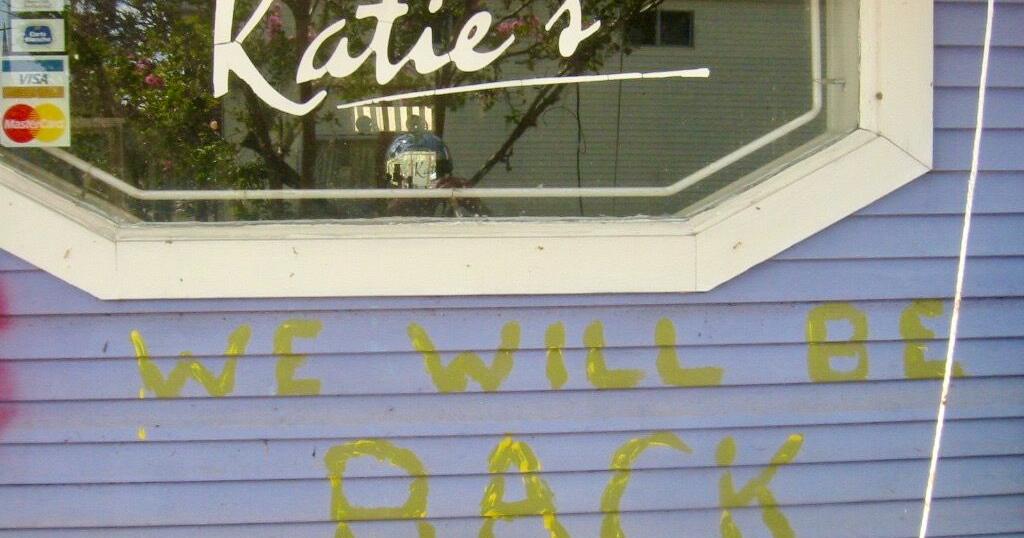
Food isn’t the first thing that comes to mind around Hurricane Katrina anniversaries. And yet, for me, the story of how New Orleans people fought their way back after Katrina is entwined with tales of our food, and that stretches on after the anniversaries have come and gone.

A sign on a home in Mid-City in the fall of 2005 offers red beans and rice, supplies and help to neighbors returning after Hurricane Katrina.
The stories come back through sense memories, anchored somewhere latent and deep, involuntarily evoked now by everyday life in this city.

A banner on display on Frenchmen Street in New Orleans in October 2005 sends a post-Katrina message. (Photo by Ian McNulty)
The crinkly sound of a foil sheet pan being peeled back, and the meaty gush of jambalaya within, still carries the generosity of Louisiana people cooking big batches of our shared regional comfort food to feed others in the evacuations, when comfort was desperately needed.

Betsy’s Pancake House on Canal Street in New Orleans shows signs of reopening in the spring after Hurricane Katrina, photographed 2006.
The smell of burgers outside the French Quarter restaurant Port of Call never fails to conjure that surreal early fall of 2005, when we were trying to compute incalculable tragedies, but finding a restaurant back open was somehow a signal that all was not lost.

Taco trucks were another sign of the times in post-Katrina New Orleans.
It can be a taco truck, where between lukewarm Mexican Coke and blazing hot green salsa there’s gratitude from when handmade meals like this meant a break from dusty work days cleaning up the mess.

A plate of tacos from a taco truck on Claiborne Avenue in the post-Katrina recovery period in New Orleans. (Photo by Ian McNulty)
Unknown in New Orleans before the levee breaches, these trucks seemed to arrive faster than FEMA relief, and they’ve since made a permanent change to the city’s street food scene.

Liuzza’s Restaurant & Bar in Mid-City dates to the 1940s and reflects the history of its neighborhood.
Just let me catch a whiff of onion rings through the kitchen door at Liuzza’s Restaurant, and I’m back on the dark Mid-City street watching its vintage neon flicker back on after many months.

Tradition, technique and improvisation often fuel crawfish boiling recipes.
The spice of a good crawfish boil can revive that post-Katrina spring, when new green started pushing through gray dead grass and gardens, and when having friends over might for once mean peeling seafood instead of gutting walls.

The Shades of Praise choir sings on the porch of a Mid-City home in the spring of 2006 when rebuilding work after Hurricane Katrina was still inching along.
Then there’s a certain type of barbecue, with a thick, red sauce, the barbecue of New Orleans street parties and parade routes. It can still summon the jubilation of homecoming gatherings as barren neighborhoods pulsed back to life, and the way strangers might drag you in to join the party, simply out of fellowship for being back home.
Lift the lid on red beans and maybe in the steam there’s the quiet relief of finally cooking in your own home once again, despite it all.

Flood lines on a Broadmoor home line up with a sign of determination to rebuild in the spring after Hurricane Katrina, photographed in 2006.
Food memories often come from our happiest moments. But life has more in store of us than joy. In New Orleans, where food constitute so much of our shared culture, food memories can also be hard wired through hard times. They can take us take us back, and also remind us how far we’ve moved forward.

This article was originally published by a www.nola.com . Read the Original article here. .