

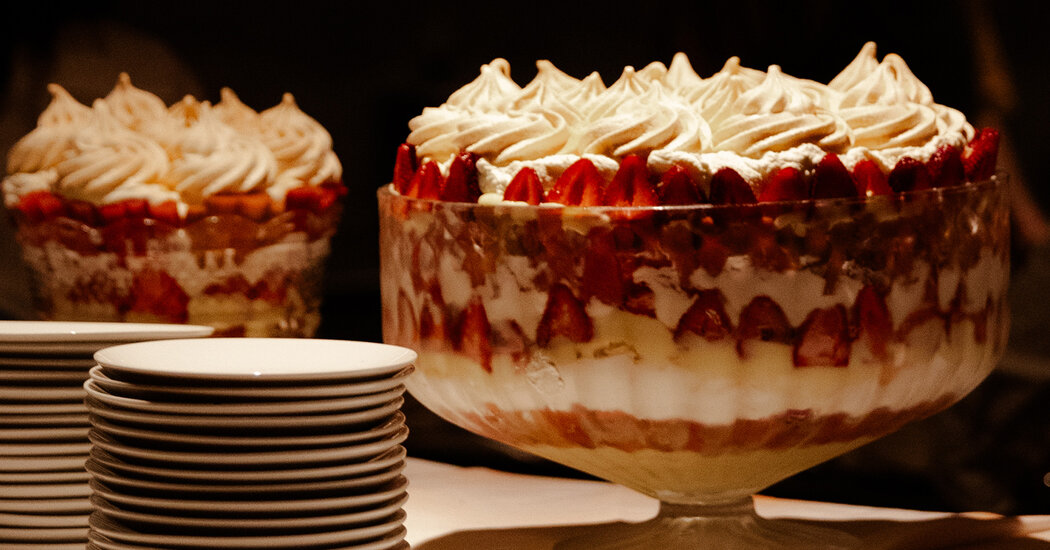
In classic British fashion, the trifle — perhaps the most quintessentially English dessert — is an almost comical understatement, its name suggesting a light snack when the dish itself is an indulgent, multilayered, alcohol-soaked production. The moniker was more accurate in the 16th century, when it referred to a simple pudding made from clotted cream mixed with sugar and rosewater. But in the Victorian era, the trifle evolved into a more elaborate creation: leftover cake or biscuits piled into a generous, footed glass bowl, saturated with a fortified white wine known as “sack” and sandwiched between fresh fruit, custard, jelly (gelatin made from calves’ feet), syllabub (alcohol-infused whipped cream) and a precursor to modern-day sprinkles made from caraway seeds coated in colored sugar. According to the English food historian Ivan Day, while the exact origins of the confection are unknown, it likely evolved from an amalgamation of several desserts. “On an aristocratic table in 18th-century England you’d have a range of different sweets: biscuits, which they dipped into wineglasses, jellies, custards, syllabub and coated caraway seeds to freshen breath and aid with digestion,” he says. “Trifle became all those dishes mixed together in a bowl.”
A number of variations soon evolved, many of them with playful names like “whim wham” (made with orange, brandy and sherry), “tipsy laird” (a Scottish take typically served on Burns Night) and “zuppa inglese” (an Italian version featuring ladyfingers). In the centuries since, the trifle has always had a place on the English table, whether as the conclusion to a Sunday roast at home or the centerpiece of a royal celebration. Lemon and amaretti trifle was the official Platinum Jubilee pudding for Queen Elizabeth II in 2022, and King Charles commissioned one made from strawberries and Yorkshire parkin, an oatmeal and molasses cake, for his coronation last year. Now, however, a new generation of chefs are elevating what has long been seen as a fusty classic into an often over-the-top feature of fashionable dessert menus.
This past June, New York’s Superiority Burger — the wildly popular vegetarian fast-food joint in Manhattan’s East Village founded by Brooks Headley, 52, formerly the executive pastry chef at the Michelin-starred Del Posto in New York — was offering a “Vegan Spring Trifle” created by the restaurant’s pastry chef, Katie Toles, 27, composed of polenta cake, almonds, rhubarb, kumquats, strawberry mousse and vegan whipped cream. Earlier this year, Mina Park, 31, the owner of 99, a bakery in Brooklyn’s Bushwick neighborhood known for its Southeast Asian-inspired whipped cream cakes, concocted a citrus and meringue version for her dinner series at the Brooklyn wine bar Rhodora. And Lauren Schofield, 31, a New York-based pastry chef who has worked at King and Marlow & Sons, recently made trifles for two private parties. One, for the chef and food writer Andy Baraghani’s wedding, involved amaretti cookies and a pistachio Bavarian cream. Another, for the launch of the painter, designer, and creative director Xavier Donnelly’s collection with Backdrop paints, featured meringue, fresh strawberries and poached rhubarb. “Trifle is a very event-friendly dessert because you can assemble it on-site and make a lot of the ingredients ahead of time,” she says. “And if you’re neat and tidy, you can make a really impressive cross section when you serve it.”
Indeed, the trifle satisfies the food world’s current appetite for nostalgia — and looks great on social media, too — but it’s not a new arrival to the States. Schofield’s affection for the dessert dates back to her childhood in North Carolina, where the sweet, popularized by British settlers in the 1800s, was renamed the tipsy parson and is often a semi-homemade affair. “My mom would make a trifle with store-bought angel food cake, blueberries, strawberries and whipped cream,” Schofield says. Cassidee Dabney, 45, an executive chef at the Barn at Blackberry Farm in Townsend, Tenn., grew up with a similar version. “You’ll find trifles at every potluck and church function in the south. You see people pull out etched-glass trifle bowls passed down from their grandmothers, and the recipes are passed down, too,” says Dabney, whose grandmother’s take included Sara Lee poundcake doused with fruit-infused vodka and layered with Kozy Shack instant pudding, fresh fruit and Cool Whip. Dabney’s version, which she serves at the hotel in the summer, is another thing entirely: Almond flour blondies are drenched in brandy and topped with peaches and custard flavored with wild ginger, bee balm or sorrel — all fresh from the estate’s garden.
In the birthplace of the trifle, meanwhile, some of the most innovative chefs are now serving fresh takes on the original. Inspired by an 1858 recipe, the chef Heston Blumenthal’s tipsy cake — on the menu at his Michelin-starred Dinner by Heston Blumenthal in London’s Knightsbridge district — consists of a baked-to-order brioche floating in a hot bath of brandy custard with a slice of roasted pineapple. The New Zealand-born chef Margot Henderson, 60, also serves trifle at her restaurant Rochelle Canteen in Shoreditch. Her typical formula: a light sponge soaked with Calvados or sherry and topped with seasonal fruit jelly, cream and nut brittle. “It’s about the layers and dipping that spoon deep down and finding different textures and flavors,” she says of the sweet’s appeal. The Irish chef Max Rocha, 34, an alumnus of the London culinary institutions the River Café and St. John Bread and Wine, also put trifle on the menu at Café Cecilia, his restaurant in Shoreditch, which is known for its desserts. “We like to not waste anything, so instead of making sponge for the trifle, we use the offcuts of our bread-and-butter pudding and soak them in sherry,” he says, adding that he then layers on custard, seasonal fresh fruit and softly whipped cream. “It’s elegant and timeless and people feel a sense of occasion — like they might be in the 16th century for the moments they eat it.”
This article was originally published by a www.nytimes.com . Read the Original article here. .