

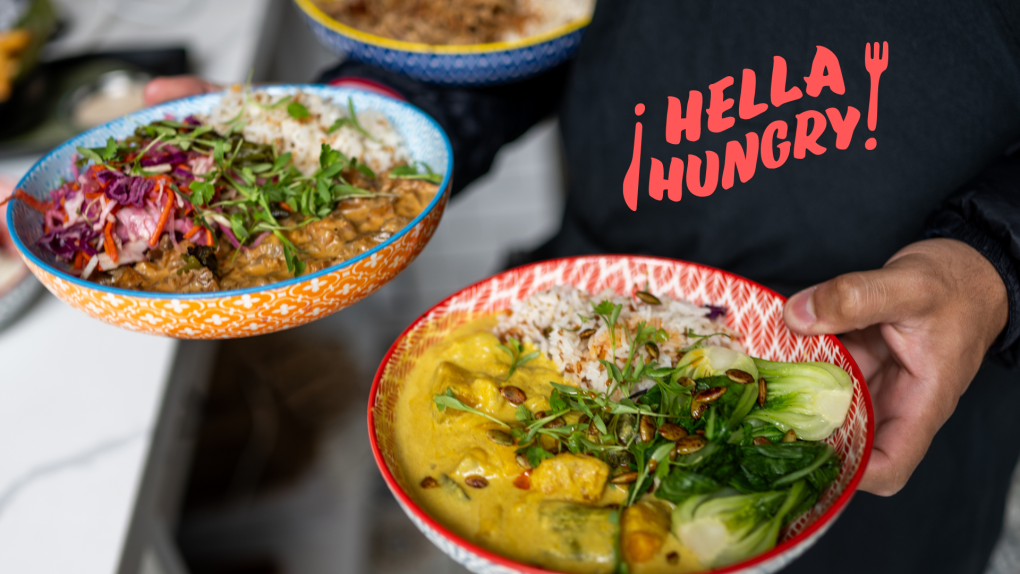
The restaurant additionally offers a bold kamayan dinner meant to be eaten with one’s bare hands: an island-style platter for large groups served on giant banana leaves piled high with fish, fruit, vegetables and lumpia.
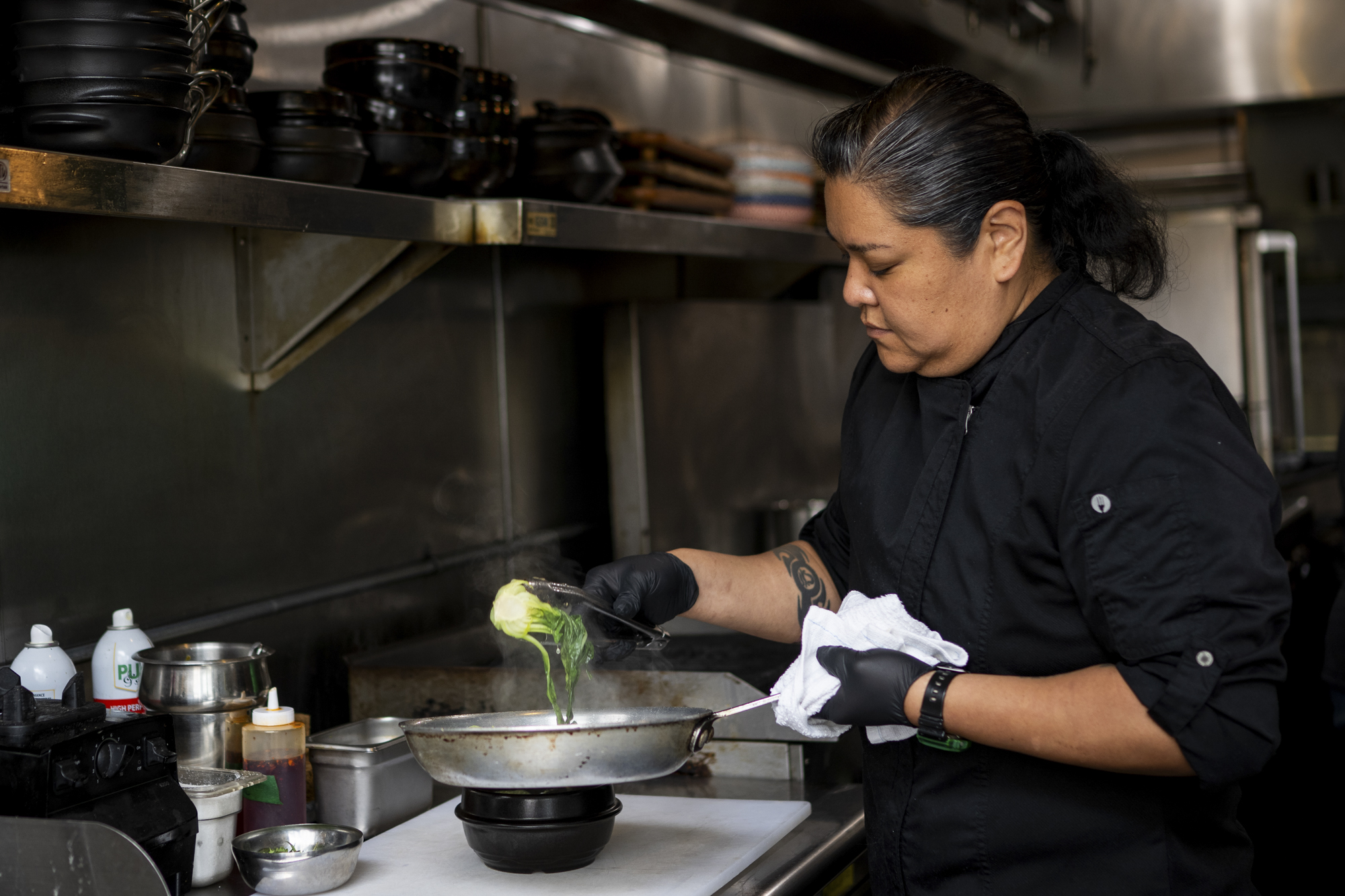
The vegan-leaning offerings are at once succulent, tropical and abundant — a reflection of both Sison’s health-conscious dietary shifts and chef Syl Mislang’s heritage as a Filipina Mexican. There’s also a hefty dose of savory proteins like pork adobo, grilled shrimp and cured pork belly.
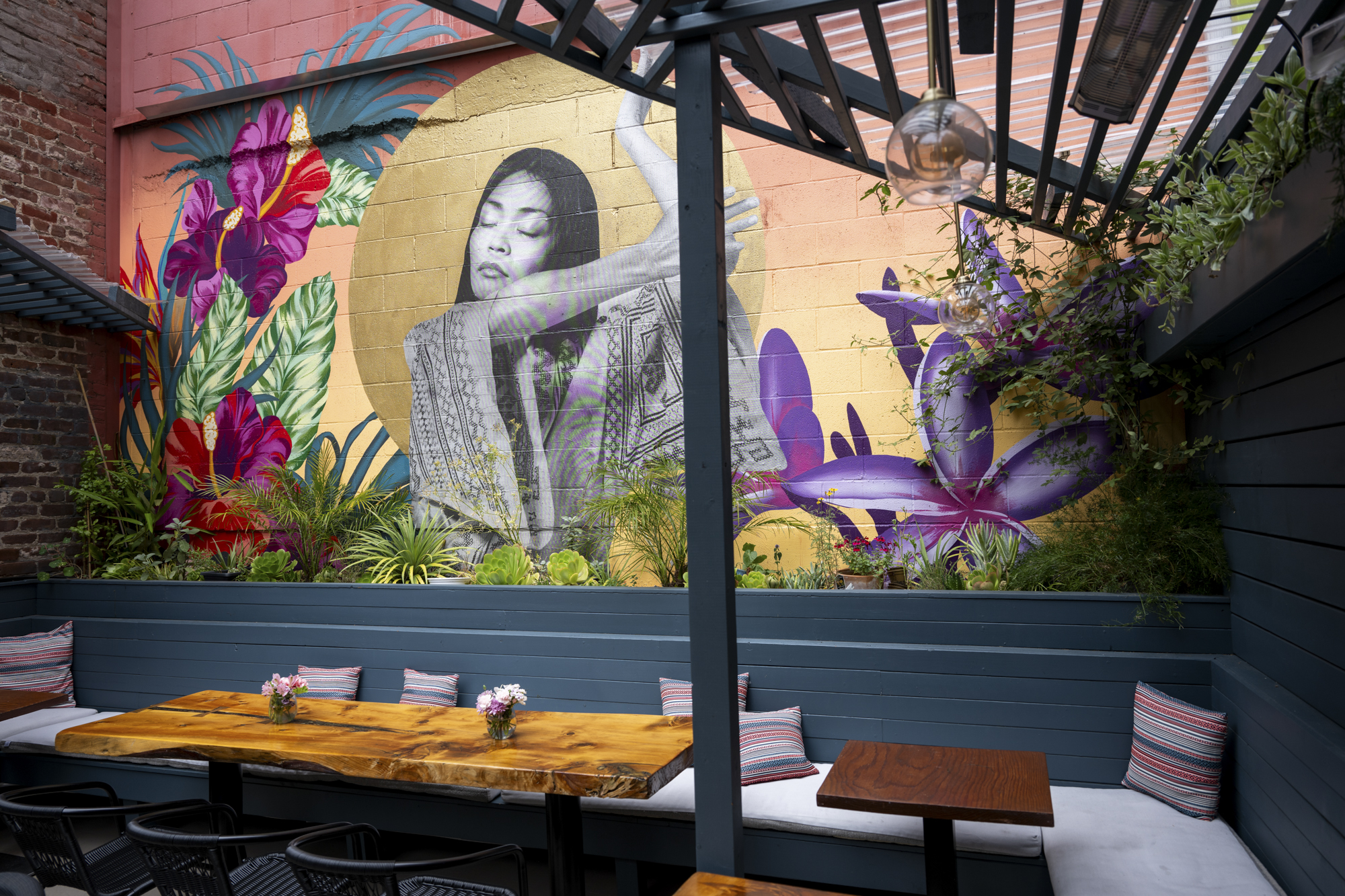
When I visited Sison at the new location, I could see why she refused to let it all go. A sense of place (there’s a vibrant Cheyenne Randall mural on the back wall) and family (Sison’s mother regularly visits to water the patio plants) was palpable.
For Sison, who has worked in SoMa since arriving in the Bay Area from Florida in 1999, Mestiza is about more than her culinary ambitions. It’s also a reflection of everything she has risked in pursuit of a fuller identity. She came to the Bay Area as a film student eager to build community, particularly among Pinoys, a group she admits was scarce in the American South of the ’80s. Decades later, in Sison’s homebase of San Francisco’s Filipino Cultural District, she hasn’t backed down from her original intentions.
In its most elemental nature, Mestiza reminds us that, no matter the setbacks, our hunger should never go unattended — especially when that hunger feeds a sense of self.
This interview has been edited for length and clarity.
********
Alan Chazaro: What’s your connection to SoMa? I know you’re proud of your roots here.
Deanna Sison: I was born in Florida, then moved to Germany when I was 10. I moved back to the U.S. when I went to college in Florida, but was always drawn to San Francisco. When I finished school, my one focus was to make it west: to go to San Francisco. The appeal was mainly around the diversity, but also the food culture. I came here in 1999 after college and have been here ever since. My first job was on Natoma Street. I had a Bachelor of Arts in film, and this neighborhood was a hub for independent filmmakers.
Whoa, I was not expecting that. What have been the biggest changes in the area since then?
I’ve seen the whole neighborhood evolve and go through multiple changes. There are still some remnants from that time, but there was something about SoMa that used to feel very industrial and creative, filled with artists, working-class people. It had an edginess. Through the years it has turned into mostly a tech neighborhood with echoes of that gritty, innovative atmosphere.
To be here and have my own roots feels just as important because of Filipino Americans and their history in this neighborhood. I came to this city to connect with my Filipino roots. When the neighborhood was designated as the Filipino Cultural District in 2017, it was a reawakening for me. It actually coincided with the opening of the previous Mestiza. I had been open for a year and a half before that. It was a big moment of discovery, a journey to reconnect with what it meant to be Filipino American. To be in this neighborhood. To continue that legacy that preceded my time here. It was important for me to stay in this neighborhood for those cultural and practical reasons.
I imagine Filipinos in Florida weren’t extremely visible back then. Or were they?
It didn’t feel huge. In my younger years, the Filipinos would sometimes get together. It didn’t feel like I was hanging out with Filipinos a lot though. Only during family gatherings in the community. Maybe once a month at a local park. For important celebrations. But in my school there were only one or two others. It didn’t feel as prevalent [as it does in the Bay Area].
Your mom was watering the plants when I visited. She told me she grew up in the Philippines as one out of nine children. What’s her connection to this area?
My mom was born in San Francisco and moved back to the Philippines and was raised there. But she came back to San Francisco eventually. There was just something in the ether about coming back here. It’s the only place I would choose to live anywhere in the country. Not LA. Not New York City. I actually did New York for a while. San Francisco is geographically my home.
Have you ever been to the Philippines?
I’ve only been twice in my life. The first time I was seven years old. It was eye-opening. The role that food plays in everyday life is extremely important. It’s the connector between everyone. There was never a table that didn’t have food on it. As a kid, being at my aunt’s house, they’d go out and kill a chicken to put on the table that night. They made fresh coconut milk. All of the activities of making food: preparing it, serving it, enjoying it. Food is just such a big part of your daily experience. When I went back in my 20s, I basically went from one meal to the next. Big tables laden with food. Maybe coffee in between. Food is just a magnet to come and gather and connect. I remember that clearly. Memories are captured in the taste, flavors, smells of food. Sometimes no one even had to speak. We had food.
What’s your background in the culinary world? When did you get into the food industry?
I always had second and third jobs in food service throughout my life. My first job was at Burger King. I worked in fast food, cocktailing, bussing, baking. On and on. I’ve had every role in a restaurant. Even when I was taking up jobs in film, I had a second or third job at a restaurant or bar. I found the perfect job on Craigslist working for an indie production company that created cooking shows. It was a PBS show. That was my favorite. I just wanted to watch those PBS cooking shows as a kid (laughs). Not cartoons.
The producer was at KQED, and she started Jacques Pépin and a few other series. They branched off to producing their own shows and distribution. They needed a production assistant. I ended up getting the job, and she was amazed at what I knew about cooking shows. I was there for five, six years. That was eye-opening for not just food and restaurants, but food culture. In that role I was able to go and read cookbooks, meet authors, professors, teachers. Cooking techniques. We were filming, but we had to prep a lot of food that would be aired on segments. I learned a lot that way.
How has the concept of Mestiza evolved over time, especially since closing in 2020? You took four years to re-open it.
When I first opened, the space I took over was a taqueria that I knew from my time working in SoMa. I wanted to preserve that concept of a taqueria. Having experienced it in the neighborhood, I felt it was an important thing. But I wanted to bring my own heritage to the mix. That was the original Mestiza. It was a celebration of the Mexican and Filipino connection. There was a trade route for 200 years between Manila and Mexico, and we were both colonized by the Spaniards. We share a lot of cultural aspects. Catholicism. Holidays. Our names. Ingredients. So we made the menu around that fusion. Then we closed in 2020 because of the pandemic. We flirted with staying partially open, but it just didn’t work.
Until about 2022, I had been thinking about it but not really planning on reopening it. Some developers approached me to bring the concept to certain locations. It never felt right. Then, this spot around the corner from Little Skillet and Victory Hall opened up. I remember it from my 20s, a little Caribbean lunch spot with sangrias all day long that I enjoyed. It felt like it could be the perfect place for a new iteration of Mestiza.
Where did the idea of doing more plant-forward dishes originate? What are the joys and challenges with that — especially since Filipino food can be very meat-heavy?
This article was originally published by a www.kqed.org . Read the Original article here. .